Output containers
Fragmented MP4 (CMAF)
--container cmaf writes one MP4 file: an initialization segment (ftyp + moov), then one moof + mdat fragment per 1536-sample access unit. All five profiles use strict EMDF, six blocks, and I0+D0. D0 is fixed at 640 kbps. The rest of the total goes to I0.
--total-rate accepts 1024, 1280, 1408, 1536 and 1664 kbps. The default is 1664. LFE defaults to none. Set --lfe-owner to independent, dependent or replace-independent when I0 should carry LFE, D0 should add it, or D0 should replace it. An explicit dependent count, block partition, carriage or EMDF profile must still satisfy those CMAF constraints.
For an XML job, keep selecting the container and the total rate on the CLI. In the XML, set data_rate to 640 and put the .mp4 path under output/ec3.
jocforge encode "$PWD/input.adm.wav" "$PWD/mix.mp4" --joc-layout idx4 --container cmaf --total-rate 1664
MKA and MP4
FFmpeg can remux a finished EC-3 file without re-encoding. -c:a copy keeps the JOC metadata. Replace mix.ec3 with the file produced in Layouts and objects.
ffmpeg -n -i mix.ec3 -map 0:a:0 -c:a copy -f matroska mix.mka
A .m4a suffix makes FFmpeg pick the ipod muxer. Write an MP4 first, then rename it, so the file keeps the MP4 container and the ec-3 track:
ffmpeg -n -i mix.ec3 -map 0:a:0 -c:a copy -f mp4 mix.mp4
mv mix.mp4 mix.m4a
The tested Flat 7.1 MKA opened in Adobe Audition and Windows Media Player. The tested .m4a opened in the iOS system decoder.
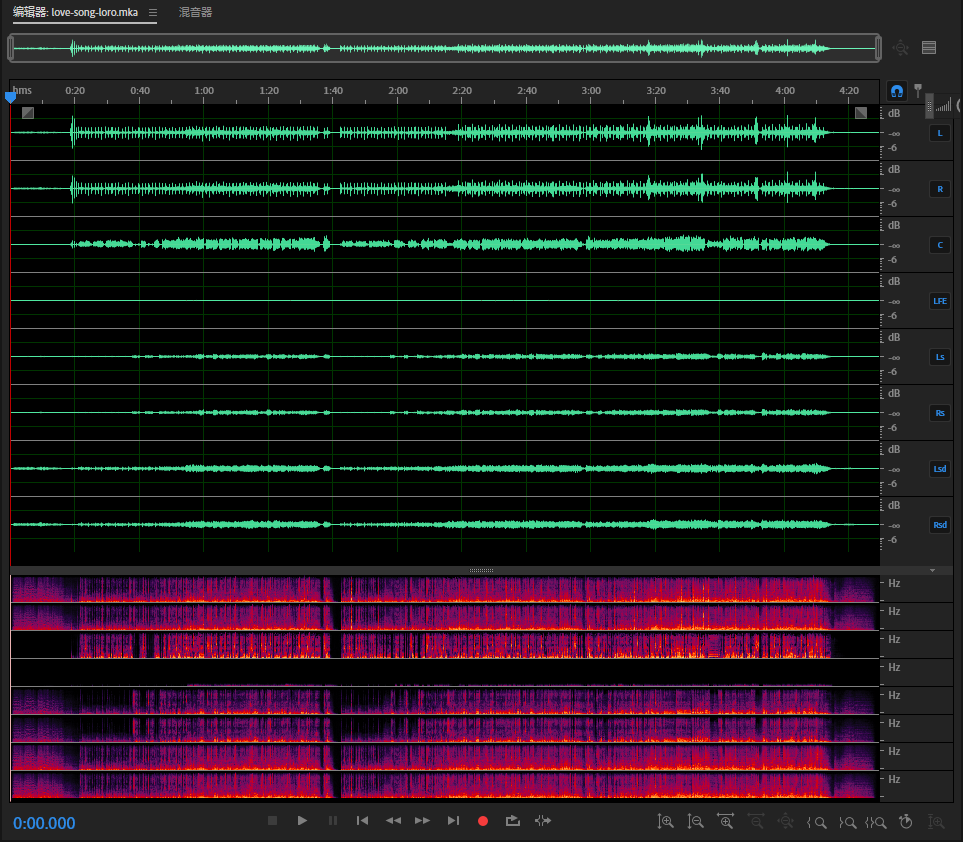
The file in the picture is a 4:29 MKA of Love Song. The eight tracks are L, R, C, LFE, Ls, Rs, Lsd and Rsd.